PEER REVIEW WORKFLOW
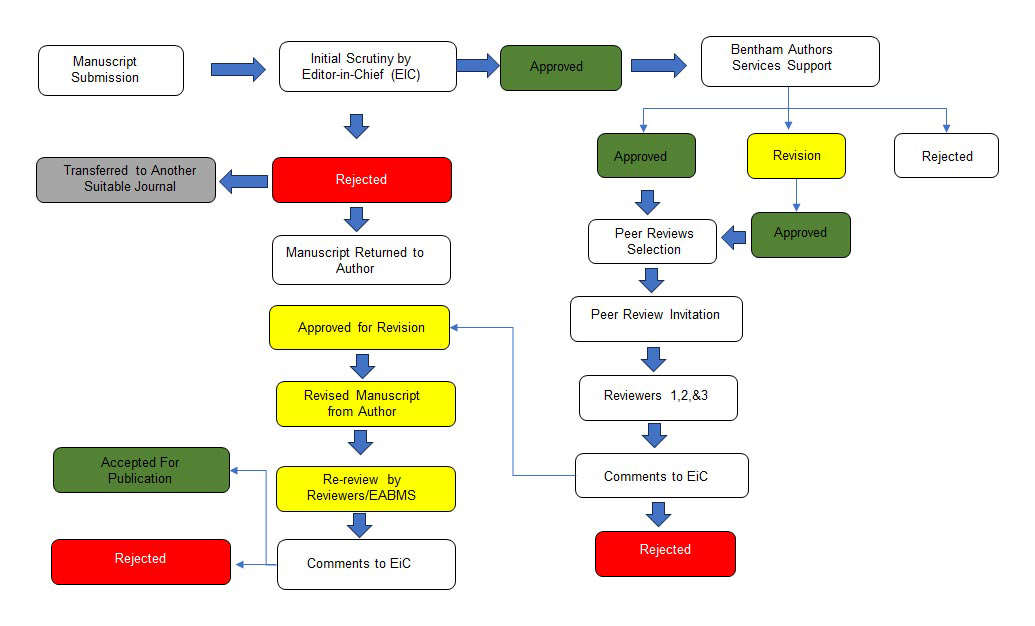
Selection of Reviewers
All manuscripts submitted to Bentham Open Science (BO) undergo a thorough peer-review process conducted by members of the journal’s editorial board, expert external reviewers, and the Editor-in-Chief. Only those manuscripts that meet our quality standards are accepted for publication.
External reviewers are selected based on their subject expertise from various international databases of peer-reviewed scientific literature. Members of the editorial board and Bentham’s reviewer panel may also be invited to share their opinion.
Peer Review Invitation
Manuscripts are forwarded to editors for initial evaluation and subsequently to independent external reviewers to check if the work presented in the manuscript:
- Falls within the scope of the journal and
- Meets Bentham Open Science’s editorial standards for originality and scientific quality.
For the initial scope assessment, editors may use their own expertise or consult additional experts.
Regarding the second point, Bentham Open Science seeks the consent of potential reviewers and editorial board members to confirm their availability and willingness to review. All communication between the editorial office and reviewers is treated as strictly confidential. The reviewers are asked to:
- Accept or decline the review invitation based on the title and abstract.
- • Suggest alternative reviewers (optional) if the reviewers decline the review invitation based on their field of expertise not being directly relevant to the article’s scope, their busy schedule, or any potential conflict of interest with the authors.
Access to the full-text version of the manuscript is provided to the agreed reviewers via our online system (https://benthamscience.manuscriptpoint.com/manuals/index.html). To use our online peer-review system module, please read the reviewer’s manual or watch the tutorial.
Bentham Open Science follows a double-blind peer review policy, ensuring that the identities of both the authors and reviewers remain anonymous throughout the entire review procedure. This process safeguards impartiality and ensures an unbiased evaluation.
Once reviews from at least two independent experts have been received—along with input from the assigned editor—a final decision is communicated to the authors via the Manuscript Processing System (MPS). The editorial decision may fall into one of the following categories:
- Requires minor changes
- Requires major changes
- Rejected with no resubmission
Responding to a Revision Request
Authors must upload their revised manuscript and a point-by-point response letter via the MPS within 30 days of receiving a revision request. The response letter should address each reviewer comment individually, describing the changes made or providing justification where a suggested change has not been incorporated
Purpose of a Review
A review report provides the editor-in-chief/senior editor with an expert opinion on the quality of the manuscript under consideration. It also offers authors with constructive feedback on how to improve their manuscript to meet the journal’s publication standards. Any remarks that could enhance the quality of the manuscript are shared with the authors for their consideration and revision.
Selfless Peer Review
Bentham Open Science (BO) is committed to ensuring objective peer review, free from self-interested bias. Reviewers are strongly advised to refrain from any form of self-promotion, including but not limited to:
- Delaying the manuscript’s evaluation due to potentially competitive work, whether currently in progress or under submission elsewhere.
- Recommending citations that are not directly relevant to the submission. During peer review, reviewers should avoid suggesting citations to their own work or that of close colleagues unless necessary for context or accuracy.
- Unless explicitly approved by the publisher, reference to articles with actual, potential, or perceived conflicts of interest must be avoided. Reviewers must adhere to the journal’s Competing Interests policy.
How to Review
Reviewers are expected to provide constructive feedback based on the following criteria (depending on the type of article):
- Does the manuscript fall within the scope of the journal?
- Is the manuscript written clearly and comprehensively? If not, how could it be improved?
- Have adequate proofs been provided for the declaration?
- Is this a new/original contribution of significance?
- Does the paper offer enough methodological detail to reproduce the experiments? In the case of experimentation on human subjects, has informed consent been taken?
- Has the author included institutional review board (IRB) approval, or stated adherence to the Helsinki Declaration for research involving human subjects in the “Methods” section?
- Have the authors followed appropriate Reporting Guidelines, i.e., CONSORT, STROBE, PRISMA, STARD, CARE, EQUATOR, in their studies (if applicable)?
- If the study involves animal experimentation, has approval from an institutional ethics committee been obtained? Is the species clearly identified in the title, abstract, and methods section?
- Bentham Open Science encourages authors to publish detailed protocols as supporting information online. Does any particular method used in the manuscript warrant such a protocol?
- Are figures/illustrations of appropriate quality?
- Is the sample size adequate for the study?
- What are the main findings of the paper?
- Is relevant work of other authors in the field appropriately acknowledged and comprehensive references given to the previous relevant literature?
If a reviewer identifies any instance of scientific misconduct, plagiarism, ethical concerns, conflicts of interest, or other irregularities, they are expected to report this immediately to the editorial office. Similarly, reviewers who feel unqualified to assess certain sections of a manuscript should also notify the editorial team.
Reviewers are required to rate manuscripts on each of the above-mentioned points and provide written remarks for both the authors and editors. For further details, please review a sample evaluation form [Template Evaluation Form]. All reviewer comments are shared with the authors, who are given the opportunity to respond. If disagreements arise between the author and the reviewer, the Editor-in-Chief will either make a final decision or assign additional reviewers for further evaluation. All efforts are made to keep Reviewer identities strictly confidential at all times.
Use of Generative AI and AI-assisted Technologies in the Peer Review Process
Peer-reviewed manuscripts and the associated review reports must be treated as strictly confidential. To safeguard author anonymity, intellectual property rights, and data privacy, reviewers must not upload manuscripts, any part thereof, or the peer review reports to generative AI tools, including for language editing purposes.
Since the process of peer review relies on human judgment, critical analysis, and original scientific evaluation, the use of generative AI or AI-assisted technologies in assessing manuscripts is not permitted. Reviewers remain fully responsible and accountable for the content, accuracy, and integrity of their review reports.
COPE Guidelines for Reviewers:
Bentham Open Science recommends that reviewers consult the COPE Ethical Guidelines for Peer Reviewers to ensure their evaluations are fair, unbiased, and ethical. Please read the complete guidelines on Committee on Publication Ethics available online.
Bentham Open Science recommends its reviewers to strictly adhere to COPE guidelines to comply with the Principles of Transparency and Best Practice in Scholarly Publishing. Please also refer to the COPE's most popular resources, i.e., core practices, flowcharts and cases (available at COPE’s website).
Confidentiality
The peer-review of a manuscript is a strictly confidential process. Reviewers are expected to maintain complete confidentiality throughout the process. If a reviewer wishes to consult a colleague for assistance with the review, they must first obtain permission from the Editor-in-Chief (EIC) or senior editor.
Reviewers must not disclose any details of the manuscript, its review status, or its content to anyone before its official publication.
Privileged Information / Transparency
Any unpublished materials disclosed in a submitted manuscript should not be used in an editor's or reviewer’s own research without the explicit written consent of the author(s). Privileged information or ideas obtained through peer review must be kept confidential and not used for personal gain.
Peer Review Manipulation
Bentham Open Science follows the guidelines established by the Committee on Publication Ethics COPE when dealing with suspected peer-review manipulation.
- Peer-review manipulation suspected during the peer-review process [VIEW FLOW CHART].
- Peer-review manipulation suspected after publication [VIEW FLOW CHART].
Review Time
Reviewers who agree to assess a manuscript are expected to submit their reports within 2–4 weeks. A timely review benefits both the authors and the wider scientific community by ensuring prompt publication. If a reviewer requires additional time, they should notify the editorial office.
Changes in Review Reports
The editorial staff relays the comments of the reviewers, on behalf of the editor-in-chief/handling editor, to the authors. The review reports may be edited by the editor-in-chief/handling editor if the comments contain confidential information or contain language deemed unsuitable for scholarly communication. Reviewers should include such comments in the confidential section of the review form—this section is visible only to the editorial team.
Conflict of Interest
Bentham Open Science respects requests from authors not to have their manuscripts reviewed by individuals with potential conflicts of interest. However, editors may not be aware of all possible competing interests. Therefore, reviewers are expected to inform the Editor-in-Chief, handling editor, or editorial manager if they identify any potential conflict during the review process. Reviewers should not contact the authors directly regarding conflicts of interest. Peer reviewers should follow journals’ policies in situations that present a conflict to impartial and unbiased reviewing. If no guidance is provided, they should inform the editorial manager in cases where: they work at the same institution as any of the authors (or will be joining that institution, or are applying for a job there), they are or have been recent (e.g., within the past 3 years) mentors, mentees, close collaborators or joint grant holders, and they have a close personal relationship with any of the authors. Reviewers are asked to re-confirm that no conflict of interest exists at the time of submitting their final review report.
Editorial Decision
Authors are typically requested to submit their revised manuscript within 15 days of receiving reviewers’ comments. The revised version is then returned to the original reviewers for further evaluation. In general, only one round of revision is permitted. In exceptional cases, a second round may be allowed. If additional revisions are still required after that, the manuscript will be rejected, and the author will be advised to resubmit it as a new submission for fresh processing.
The final decision regarding acceptance or rejection is made by the editor-in-chief, based on his/her assessment of the reviewers’ recommendations and the overall quality of the revised manuscript. In rare cases, manuscripts recommended for publication by the reviewers may also be rejected at the Publisher or Editor-in-Chief’s discretion during final evaluation.
Transferred Articles
If a manuscript is rejected due to its misalignment with the aims and scope of a particular journal, it may be offered a transfer to another suitable Bentham Open Science journal (with the consent of the author) that has a similar scope. For further details, please visit: https://openchemicalengineeringjournal.com/manuscript-transfer-facility.php
Appeals and Complaints
Editorial decisions at Bentham Open Science are generally considered final. However, authors who believe that a decision was made in error or due to a misunderstanding may submit an appeal. Appeals must include clear reasoning and compelling evidence-based responses to the concerns raised in the rejection letter. Appeals based solely on differences of opinion regarding novelty, interest, or journal fit will not be considered. The Editor-in-Chief and other relevant editorial members will consider the appeal, and the decision thereafter taken by the journal will be deemed final. A manuscript under reconsideration may be evaluated by previous or new reviewers and could require substantive revisions. Reconsideration does not guarantee acceptance.
Complaints related to ethical practices or academic misconduct will be handled in accordance with Bentham Open Science’s academic misconduct guidelines.
Authors wishing to raise a complaint should initially contact the Editor-in-Chief through the journal's editorial office. For issues involving the Editor-in-Chief, authors may escalate the complaint to the Publisher by emailing to contact us. Acknowledgment of the complaint will be issued, and appropriate action will follow, including consultation with the Editor-in-Chief, where necessary.
The complete peer-review history of each reviewer is maintained within our Online Manuscript Processing System (MPS). Reviewers earn points for each completed review, which can be redeemed as needed.
Bentham Open Science also partners with Publons, providing formal and verified recognition of reviewers’ contributions, including peer reviews and editorial activity. Learn more about Publons here: https://publons.com/publisher/219/bentham-science-publishers
Become a Reviewer
For joining our reviewers’ panel, the candidates must meet the following criteria:
- Hold a Ph.D. degree and have research experience in the primary subject area of the journal and the articles under review
- Have previous peer-reviewing experience
- Have well-cited publications in reputable journals.
Those willing to join our reviewers' panel are invited to submit their details at (REVIEWER REGISTRATION FORM)